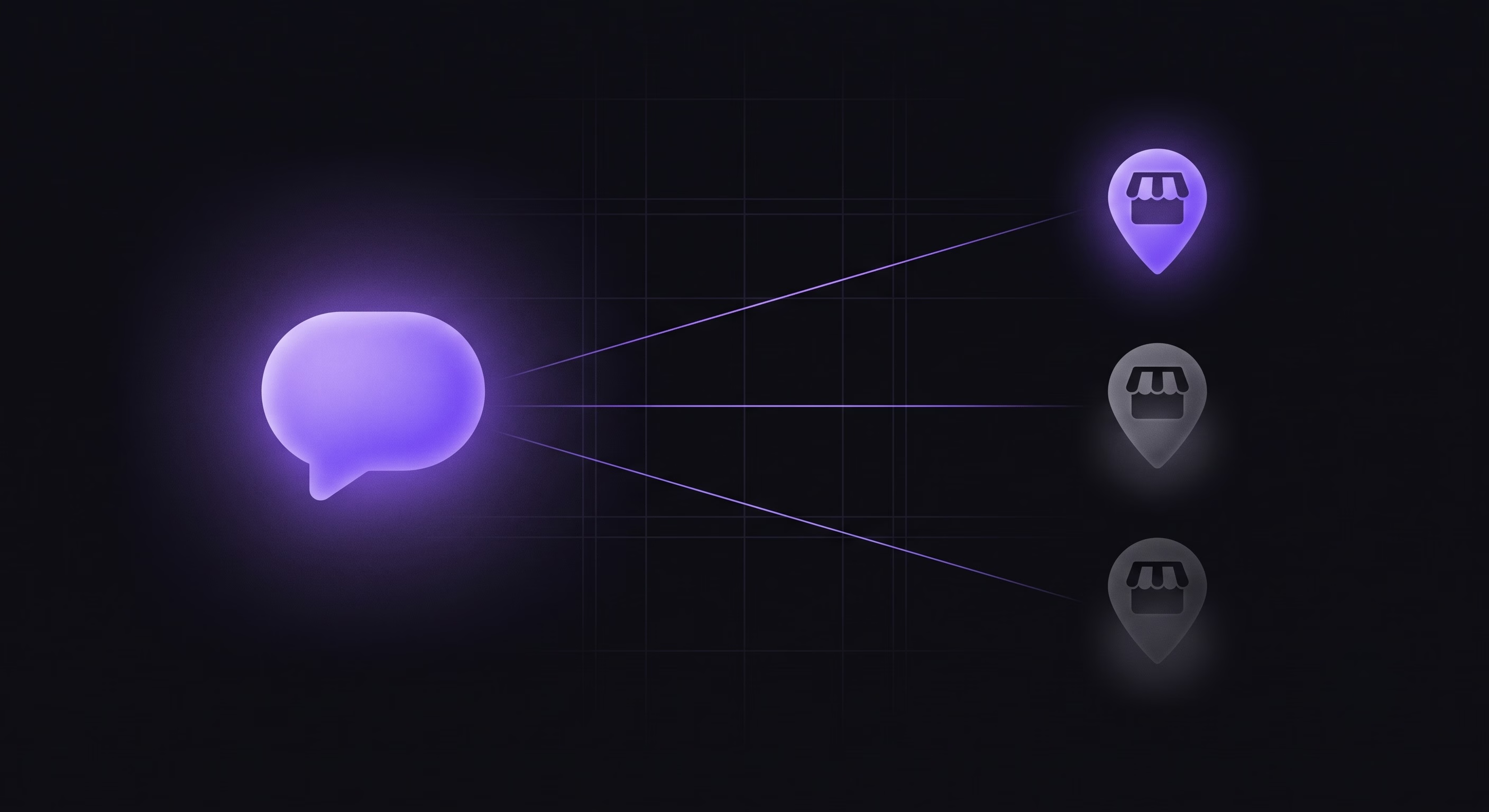
A potential customer opens ChatGPT and types: "what's the best florist in the 11th?" or "a good plumber open near République". In two seconds, the AI answers with two or three names. Yours isn't among them — while your neighbour's is. It's not bad luck or randomness: it's a technical mechanism, and it can be explained.
AI search is no longer marginal in France: about 22% of informational searches now go through ChatGPT, Perplexity, Claude or Gemini (SimilarWeb, 2026), and 32% of users use them specifically for local queries — "near me", "in my neighbourhood", "open now". So many moments where the AI chooses, in your place, who gets recommended.
Reason 1: ChatGPT doesn't search Google — it searches Bing
This is the point almost no business owner knows, and it's the most decisive. When ChatGPT needs local, fresh information, it runs a web search — and that search relies on Bing's index, Microsoft's engine, not Google's.
Since 2026 that is no longer the only channel: OpenAI also buys entire local databases and plugs in partner apps, including PagesJaunes in France since 22 June. I broke down the three doors through which an AI learns your business exists, because they do not follow the same rules.
The consequence is blunt: if you've built your visibility only on Google (Business Profile, local SEO, Google reviews) without ever worrying about Bing, you can be perfectly ranked on Google and nearly invisible to ChatGPT. The AI simply isn't looking at the same map as you.
Update, 21 September 2026: since 2026 OpenAI also runs its own index, Labrador, fed by its OAI-SearchBot crawler; Bing remains a useful floor but is no longer the single door in. I cover what that changes, and the robots.txt setting that leaves many businesses invisible without knowing it, in ChatGPT built its own search index.
The good news: Bing is a far less crowded playing field. Creating and verifying a Bing Places for Business listing, signing up for Bing Webmaster Tools and making sure your site is indexed there are quick actions — and almost nobody in local retail does them. That's exactly the kind of window where you take the lead at little cost.
Reason 2: AI only cites businesses that are "visible enough"
Even on Bing, an AI won't recommend an address it has few signals on. The models play it safe: they cite businesses that several sources agree on and whose reputation is established. Concretely, that runs mostly through reviews.
There's no official threshold, but industry testing converges on a clear order of magnitude:
- Around 25 reviews at 4.3/5 and above: the floor from which a business starts appearing in AI local recommendations.
- Beyond 100 reviews at 4.5/5: the business is cited far more often, and often first.
Three dimensions matter together: volume (how many reviews), rating (the average) and freshness (recent, regular reviews beat an old frozen pile). Replying to them strengthens the signal further — I explain how to do it without losing your evenings in this article on AI-assisted review responses.
One important nuance, from an audit published in August 2026 against a complete census of 4,776 venues: review volume does help you enter the recommendations, but the star rating has no measurable effect on whether you appear at all, and 72.6% of venues with 50 or more reviews stay invisible. The strongest measured entry factor is owning a website.
What ChatGPT actually reads about you
To decide whether to cite you, an assistant cross-checks several sources in an instant: your website, your Business Profile, directories, review platforms, sometimes social networks. Three things tip the balance:
- The consistency of your information. A strictly identical name, address and phone number everywhere (what SEOs call NAP) reassures the model. The slightest contradiction — two different opening hours, an old address lingering somewhere — sows doubt and costs you the citation.
- Your structured data. Schema.org markup (business type, hours, address, prices, reviews) is the language robots read first. Without it, you're asking the AI to guess; it would rather cite someone who doesn't make it guess.
- Factual, citable content. AI loves pages that clearly answer a precise question: "do you do alterations?", "do you take groups?", "do you deliver in the area?". An honest FAQ is one of the easiest kinds of content for a model to cite.
5 concrete actions to show up in ChatGPT
1. Exist on Bing, not just Google
Create your Bing Places listing, register your site on Bing Webmaster Tools and check that your pages are properly indexed there. It's the highest-leverage action, precisely because it's the one your competitors forget.
2. Cross the review threshold — and keep it fresh
Aim for a solid base of authentic reviews (past 25, then 100), maintain a high rating, and ask for reviews regularly rather than in one-off waves. Freshness is a signal in its own right.
3. Make your website "citable"
Complete structured data, an FAQ page that answers your customers' real questions, up-to-date practical information: give the AI sentences ready to be reused. That's the core of AI search optimization (GEO).
4. Lock in your consistency everywhere
Align your website, your Google profile, your Bing listing and the main directories word for word. The website + profile duo must tell exactly the same story — a topic I cover in this article on the Google profile and website.
5. Monitor what AI says about you
Ask them: type "best [your trade] in [your area]" into ChatGPT, Gemini and Perplexity, and see who comes up. That's the starting point of any serious AI citation work: you only fix well what you measure.
ChatGPT, Gemini, Claude: not the same plumbing
One last point that changes everything about how to go about it: the assistants don't draw on the same sources.
- ChatGPT — web search via the Bing index.
- Gemini — relies on Google and the Business Profile (it's also the engine behind AI Overviews).
- Perplexity — blends several indexes and cites its sources heavily.
- Claude — has its own web search.
In other words, there's no single magic button. Being visible everywhere means taking care of your Google SEO, your Bing presence and the signals common to all AI (reviews, structured data, consistency) all at once. That's exactly the work I describe on my AI search optimization page.
The real stakes: these visits convert
Why go to the trouble? Because AI traffic isn't traffic like any other. A visit from ChatGPT converts at around 15%, versus under 2% for a visit from classic Google search. The reason is simple: when the AI names you, it doesn't just make you visible — it recommends you. The customer no longer arrives to compare, they arrive nearly decided.
And that is precisely what an advertising budget does not buy. The first ads to appear inside ChatGPT make the point: 96% of the time, the advertiser paying for the sponsored card is not cited in the answer sitting right above it. Being recommended is earned; a slot is bought; one does not produce the other.
Local search is shifting from a system of discovery to a system of decision. The first businesses cited settle into a position the next ones will have to dislodge — and right now, in your neighbourhood, the seat is almost empty.
Frequently asked questions
Why doesn't ChatGPT recommend my business?
Usually for two combined reasons. First, ChatGPT's web search relies on Bing's index, not Google's: if you've only worked on Google, you can be nearly invisible to ChatGPT. Second, AI only cites businesses that are already well referenced and well rated — a review floor seems necessary before you appear in local recommendations.
How many Google reviews do you need to be recommended by AI?
There's no official threshold, but industry testing converges: a business starts appearing around 25 reviews at 4.3/5, and it's cited far more often beyond 100 reviews at 4.5/5. Volume, rating and freshness of reviews all matter.
Do ChatGPT, Gemini and Claude use the same sources?
No. ChatGPT's web search goes through Bing, Gemini relies on Google and the Business Profile, Perplexity blends several indexes, and Claude has its own search. To be visible everywhere you need to work on Google SEO, your Bing presence and the signals common to all AI — that's the role of AI search optimization (GEO).
Want to know what ChatGPT, Gemini and Perplexity already answer when someone searches for your business? Request an AI visibility diagnostic: I'll show you where you stand, where you're invisible, and where to start.