SEO is undergoing a major shift. While we traditionally optimized our websites for search engines and human visitors, a new audience is emerging: AI agents. With Chrome 150, Google introduces a brand-new experimental report in Lighthouse: the "Agentic Browsing" category. This is a revolution for AI SEO (AIO or LLM SEO).
What is Agentic Browsing?
"Agentic Browsing" evaluates the design quality of your website for interactions with machines, crawlers, and AI. Unlike a human who uses a mouse and screen, an Artificial Intelligence agent "reads" your site's code (specifically the accessibility tree) and uses open standards like the WebMCP protocol to interact with it.
Google decided to offer deterministic audits in Lighthouse to help developers prepare their sites for these automated assistants.
A score unlike other Lighthouse audits
Unlike Performance or classic SEO audits in Lighthouse, the Agentic Browsing category doesn't give a traditional 0-to-100 score. Since the standards are still being developed, the tool instead provides:
- A fractional score: for example, the number of successful checks out of the total critical points.
- A Pass/Fail status for specific technical points (such as the validity of a WebMCP schema).
Key criteria analyzed by the audit
For now, the audit focuses on several fundamental areas to ensure that AI understands and can seamlessly use your website:
1. WebMCP Integration
Lighthouse checks the registration of your tools via the Chrome DevTools Protocol (CDP). It ensures that you correctly expose your forms and application logic to AI agents, whether declaratively (HTML) or imperatively (JavaScript).
2. "Machine-Centric" Accessibility (a11y)
The accessibility tree is no longer just designed for screen readers for visually impaired users: it has become the primary data model for AI agents! The audit closely scrutinizes:
- Names and labels: every button or interactive field must have an explicit programmatic name (ARIA attributes, HTML labels).
- Tree integrity: semantic roles and relationships (parent/child) must be logical and valid.
- Visibility: interactive content must not be hidden in the code while remaining virtually "clickable" for the machine.
3. Visual Stability and Detectability
Autonomous agents hate unstable interfaces:
- Cumulative Layout Shift (CLS): an element that shifts upon loading (due to a dimensionless image or an ad) risks misleading the AI agent right when it tries to click on it. Stability therefore becomes an AI navigation issue.
- The
llms.txtfile: Lighthouse checks if you have placed anllms.txtfile (the new standard, cousin torobots.txt) at the root of your domain. This file must contain a concise and machine-readable summary to guide it.
Why your results may fluctuate between audits
Your scores may vary from test to test. Dynamic tool registration via JavaScript, changes in your DOM complexity, or simple layout shifts (CLS) directly influence an agent's ability to predictably scan your page in real-time.
The ultimate goal: 4x100 and perfect Agentic Browsing
Striving for technical excellence isn't just about developer pride. Achieving 100/100 across the 4 standard criteria (Performance, Accessibility, Best Practices, SEO) and passing all checks in the new Agentic Browsing score guarantees your site is at the cutting edge of the industry.
Here is what a perfect Google Lighthouse audit looks like:
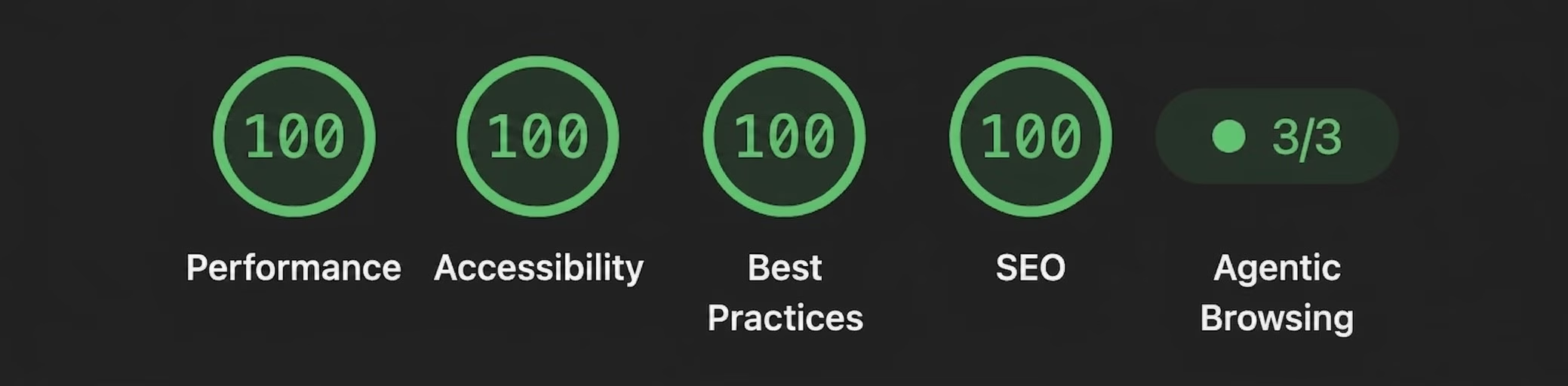
This is exactly the level of optimization (both AIO and classic SEO) that users and AI agents expect today to make your platform a top-recommended reference.
How to prepare your site for AI today?
LLM Optimization (LLMO) or Artificial Intelligence Optimization (AIO) is no longer a futuristic concept, it's a tangible reality:
- Adopt WebMCP to expose your features comprehensibly.
- Have a flawless a11y tree: use strict semantic HTML. Keep in mind that it's the only "view" the machine has of your page.
- Optimize your CLS: minimize visual shifts as much as possible.
- Publish an
llms.txt: make tasks easier for LLMs by documenting your site for them.
The era of autonomous agents and semantic web 3.0 is just beginning. Contact me if you would like an audit of your site to ensure it is ready to be explored and recommended by Artificial Intelligence.